
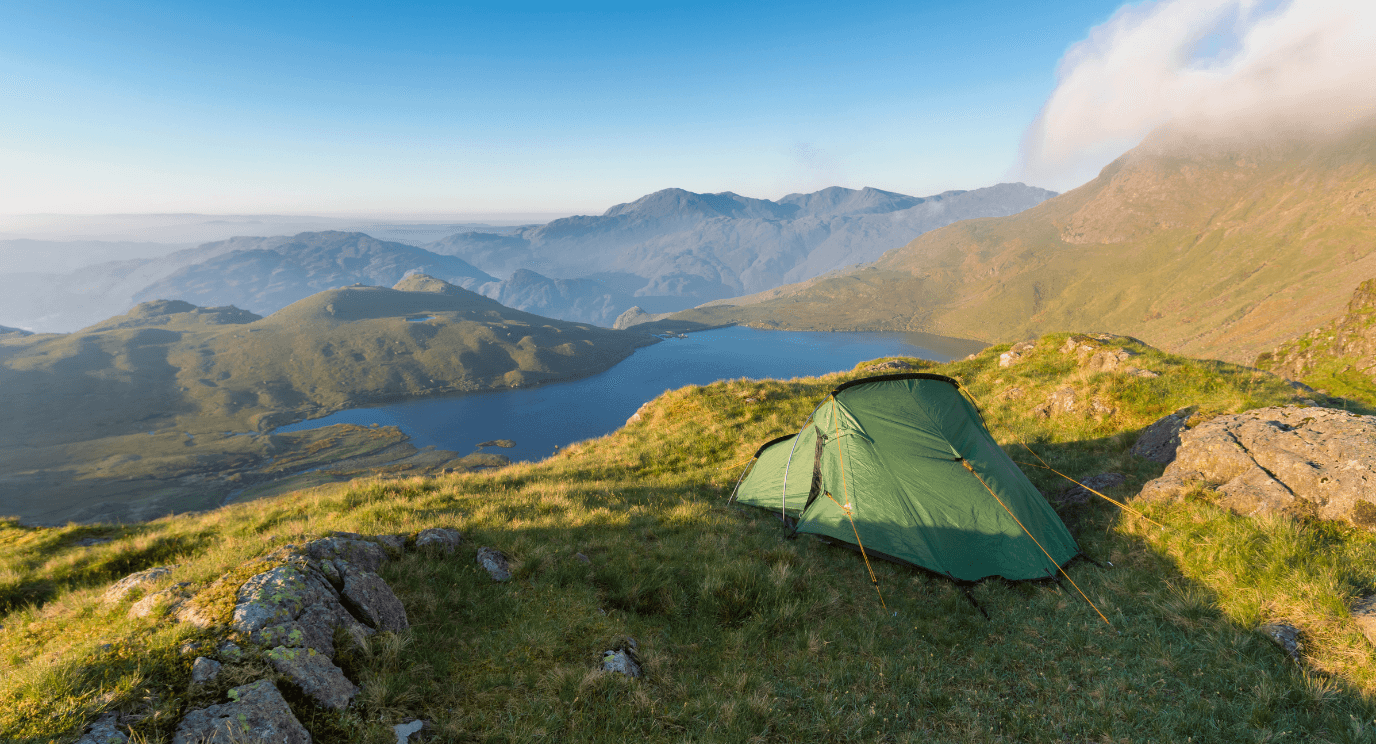

There's nothing quite like waking up in the hills with nobody else around: the tent wet with dew, the first light on the tops, and the kettle on. If you've never wild camped before, it can feel daunting. This guide covers what you need to know to do it legally, safely and responsibly.
It's written for first-timers, but there's plenty here if you've camped on campsites and want to try something wilder.
Inside: the law in England, Wales, Scotland and Northern Ireland (including the Dartmoor rulings), choosing a spot, tents vs bivvy bags, a basic kit list and how to leave no trace.
Start with the law, because it varies a lot depending on where you are.

What is Wild Camping?
Wild camping means camping away from a campsite, usually for one night in a quiet, remote spot, with no facilities. It gives you the freedom to choose where you sleep, along with the responsibility to follow the local rules and leave no trace.
Why Wild Camping is a Great Thing to Do
Here's why it's worth doing:
Freedom and Connection to Nature
Out of signal and away from screens, you notice far more: the light, the weather, the sounds at dusk and dawn.
Adventure and Unpredictability
Every trip is different, whether it's a high camp in the Lake District or a sheltered spot by a loch in the Highlands.
Community of Like-Minded People
There's a friendly community of wild campers too, with plenty of online groups sharing tips and advice.
Multi-Day Hikes
If you're walking a multi-day route, such as a long-distance trail on Dartmoor, wild camping means you can stop where the day ends rather than where the campsites are.
If you want to really get away from it all, a night out under canvas is one of the best ways to do it.

The Legalities of Wild Camping in the UK
The rules differ across the UK, so check before you go:
England and Wales
In England and Wales, you need the landowner's permission to camp almost everywhere, including most open hill land and the coast. The exception is Dartmoor, where the right to camp on much of the common land is protected by law (see below).
In practice, wild camping is tolerated in some upland areas if you're discreet: pitch late, leave early, stay one night, keep away from houses and farmland, and leave no trace. It isn't a legal right, though, so if a landowner asks you to move on, do so politely.
Scotland
In Scotland, the Land Reform (Scotland) Act 2003 and the Scottish Outdoor Access Code give you the right to camp on most unenclosed land, as long as you camp responsibly and leave no trace. The exception is the camping management zones in Loch Lomond and the Trossachs National Park, where you need a permit (or a campsite) between March and September.
Northern Ireland
Northern Ireland is similar to England and Wales: you generally need the landowner's permission. Check the local council or land manager's guidance before you go.
National Parks
National parks have their own rules. Wild camping is banned in the New Forest, for example, and generally needs the landowner's permission in the Lake District and Bannau Brycheiniog (the Brecon Beacons), though discreet high-level camping is often tolerated in the Lakes. Always check the guidance for the park you're visiting.
High Court and Court of Appeal Rulings on Wild Camping in Dartmoor
Dartmoor was the one place in England with a widely accepted right to wild camp, and it was challenged in court by a landowner who argued that camping didn't count as "open-air recreation". In 2023 the High Court agreed with him, briefly ending the right.
The Dartmoor National Park Authority won its appeal at the Court of Appeal later in 2023, and in 2025 the Supreme Court upheld that ruling. Under the Dartmoor Commons Act 1985, the public can camp on Dartmoor's commons, within the areas and rules set by the National Park Authority. Check the National Park Authority's camping guidance and map before you go.
Where You Can and Can’t Wild Camp
Here's a quick guide to where you can and can't camp:
National Parks
- Dartmoor National Park: One of the few places in England where wild camping is permitted on common land.
- Lake District: Tolerated in higher fells, away from populated areas.
- Brecon Beacons: Certain areas allow for wild camping with landowner permission.
- Scottish National Parks: Generally permitted due to Scotland’s more lenient laws.
Coastal Areas
- Although there are no specifics as to where wild camping is tolerated along the coastline, there are many people who tackle long-distance walks like the South West Coastal Path, wild camping along the 630-mile route.
Urban Areas
- Wild camping is generally not advised in urban areas due to legal restrictions and safety concerns.
Resources for Finding Spots
- Google Maps: A useful tool for initial scouting.
- Local Council Websites: Often provide information on camping regulations.
- Interactive Maps: Some National Parks offer these to help you find the best spots.

Tips for Choosing Your First Wild Camping Spot
Instagram might show you a thousand images of summit wild camps, where the lucky campers are waking up to a beautiful cloud inversion, but if you’re a first-timer then you should really start with something more local and less challenging than the highest peaks.
For your first attempt, try something local and somewhere you know relatively well. Then, if something does go wrong you won’t be quite so far out of your comfort zone. As your skills and confidence grow you can start thinking about heading further afield.
If you’re thinking that a local adventure isn’t going to tick the box of the ‘big’ adventure you were looking for, I urge you to read Microadventures, it will completely change your perspective on this.
Do your research, and you'll find a spot that's beautiful, quiet and legal.
Leave No Trace Principle
Wild camping is a privilege that comes with its own set of responsibilities. One of the most important principles to adhere to is “Leave No Trace.” This ethos not only ensures that you minimise your impact on the environment but also helps to preserve the natural beauty of the land for future generations. Here’s how to practice it:
- Research the area and camping regulations before you go.
- Obtain any necessary permissions.
- Stick to established trails when travelling.
- Choose durable surfaces for setting up camp.
- Camp at least 200 metres away from water sources.
- Remove all rubbish and litter.
- Avoid disturbing local wildlife.
- Use a camping stove for cooking.
- If fires are allowed, safety is paramount.
- Keep noise levels low.
- Respect the privacy of other campers.
- Leave the campsite as you found it, or better.
By following the Leave No Trace principle, you’re not just a visitor but a steward of the great outdoors. It’s a simple yet effective way to ensure that the wild spaces we love remain beautiful and accessible for years to come.
Essential Gear for Wild Camping
The two main shelter options are a lightweight tent or a bivvy bag.
Tents
-
Size: Consider how many people will be camping and how much gear you’ll have. Tents are usually rated by the number of people they can accommodate.
-
Weight: If you’re hiking to your camping spot, weight is a critical factor. Look for lightweight, backpacking-friendly options.
-
Hydrostatic Head (HH) Rating: This measures how waterproof the tent is. A higher HH rating means better water resistance. Aim for at least a 2000mm HH rating for UK conditions.
-
Read our guide to the Best Wild Camping Tents for Under £150
Bivvy Bags
- Size and weight: bivvy bags are much smaller and lighter than tents, which makes them good for solo trips and fast, light overnights.
- Breathability: choose a breathable bivvy bag to limit condensation inside.
- Weather: a bivvy is less weatherproof and less comfortable than a tent in wind and rain. Check the fabric and the hydrostatic head rating if one is given.
Tents vs. Bivvy Bags: A Quick Comparison
- Best for Tents: Tents are ideal for longer trips, harsh weather conditions, or when camping with multiple people. They offer more space and comfort but can be heavier to carry.
- Best for Bivvy Bags: Bivvy bags are perfect for solo adventures, quick overnight stays, or when you need to keep your pack as light as possible. They offer less space but are much easier to set up and take down.
Sleeping Arrangements
Sleeping Bags
- Temperature Rating: Choose a sleeping bag that’s appropriate for the season and weather conditions you’ll be facing. Look for bags with a comfort rating that matches the lowest temperature you expect to encounter.
- Insulation Type: Sleeping bags come with either down or synthetic insulation. Down is lighter and more compressible but less effective when wet. Synthetic insulation performs better in damp conditions.
- Weight and Packability: If you’re hiking to your campsite, opt for a sleeping bag that is lightweight and easy to pack.
Sleeping Mats: Comfort vs. Weight
- Foam Mats: These are the most basic and usually the cheapest. They provide a layer of insulation but are generally less comfortable.
- Self-Inflating Mats: These offer a good balance between comfort and weight but can be bulkier than other options.
- Inflatable Sleeping Mats: These are a great lightweight option that doesn’t compromise on comfort. They can be inflated to your desired firmness and are usually very compact when deflated.
By investing in a quality sleeping bag and mat, you can improve your comfort and the quality of your sleep while wild camping. Inflatable sleeping mats, in particular, offer a fantastic blend of comfort and portability, making them an excellent choice for those looking to keep their backpack light without sacrificing a good night’s sleep.
Cooking and Food Storage
A lightweight stove is an excellent choice for wild camping, especially if you’ll be hiking to your camping spot. These stoves are perfect for quickly warming up food or boiling water for hot drinks. They usually run on small gas canisters or alcohol, both of which are easy to pack and carry. Some models are even compatible with multiple fuel types, offering greater flexibility. Pair your stove with lightweight, durable cookware like titanium or aluminium pots and pans for the best experience.
When it comes to food, opt for non-perishable items that don’t require refrigeration, such as canned goods, pasta, or dehydrated meals. Planning your meals in advance can help you bring the right amount of food, minimise waste, and make meal preparation easier. A lightweight stove allows you to enjoy the luxury of hot meals and drinks without the burden of carrying heavy cooking equipment, enhancing your wild camping experience.
Useful Items
- Water Filter or Purification Tablets: Essential if you’ll be sourcing water from lakes or streams.
- Water Bottles or Hydration System: Make sure you can carry enough water for your trip.
- Map and Compass: Even if you use a GPS, always carry a traditional map and compass as a backup.
- GPS or Smartphone: Useful for tracking your route but remember to save offline maps.
- First Aid Kit: Should include basics like bandages, antiseptic wipes, and any personal medication.
- Emergency Whistle and Firestarter: Important for attracting attention in case of an emergency.
- Headlamp or Torch: For navigating in the dark.
- Multi-tool: Useful for a variety of tasks, from cutting rope to opening cans.
Remember, the key to a successful wild camping trip is preparation. Make sure you have all the essentials to ensure your safety, comfort, and enjoyment while out in the great outdoors.
How to Find the Perfect Wild Camping Spot
Choosing the right spot for your wild camping adventure is crucial. Not only does it need to be a legal and responsible choice, but it should also offer the kind of natural beauty and solitude that makes wild camping so special. Here are some tips to help you find that perfect spot:
Utilise Online Resources
- OS Maps: A great starting point for scouting potential locations. Look for remote areas away from roads and urban centres.
- Forums and Social Media: Communities of like-minded people can offer valuable insights and recommendations.
Check Local Regulations
- Always verify the rules and regulations for wild camping in your chosen area. Websites for national parks or local councils often provide this information.
Consider Accessibility
- Public Roads and Car Parks: If you’re driving, consider how close you can get to your chosen spot without breaking any rules.
- Public Transport: For those without a car, look for spots that are a short walk from public transport links.
Assess the Terrain
- Water Sources: Proximity to fresh water is essential, but make sure you’re not too close to avoid flooding risks.
- Safety: Avoid cliff edges, unstable ground, and other potential hazards.
Test for Mobile Reception
- While the idea is to disconnect, having some mobile reception can be a safety net in case of emergencies.
Visit in Daylight
- If possible, scout your chosen spot during daylight hours to assess its suitability and to familiarise yourself with the area.
Trust Your Instincts
- Sometimes a place just feels right. Trust your gut when choosing your wild camping spot.

Do Wild Campers S*!t in the Woods?
Even in the great outdoors, nature’s call is inevitable. However, it’s crucial to handle this in a way that’s both respectful to the environment and other people. Here are some tips:
Solid Waste
- Dig a small hole at least 200 feet away from water sources, trails, and campsites. The hole should be about 6-8 inches deep.
- Use toilet paper sparingly and pack it out in a sealed plastic bag. Alternatively, use biodegradable wet wipes and pack them out as well.
Liquid Waste
- Urinate at least 200 feet away from water sources to prevent contamination.
- Choose a spot that’s well away from trails and campsites to maintain privacy and respect for other visitors.
Biodegradable Soap
- If you need to wash, use biodegradable soap and scatter strained dishwater at least 200 feet away from water sources, trails, and campsites.
Leave No Trace
- Fill in any holes you dig, and take everything away with you.
By following these guidelines, you can answer nature’s call without leaving a lasting impact on the natural environment, ensuring that the great outdoors remains a clean and pleasant place for everyone.
Additional Tips and Tricks
Wild camping is an adventure, and like any adventure, it comes with its own set of challenges. However, a little preparation and some smart choices can go a long way in ensuring a successful wild camping trip. Here are some additional tips and tricks:
- Always check the weather forecast before you head out and prepare for all conditions. Wet weather gear is a must, even if the forecast is clear.
- Always let someone know where you’re going and when you expect to return. Carry a fully charged mobile phone and a portable charger for emergencies.
- Respect local customs, especially in rural areas. If you’re unsure about the rules for a particular area, it’s always a good idea to ask local residents or consult local council websites.
- Be aware of the local wildlife and take necessary precautions. We don’t have to worry about bear spray in the UK, but some midge repellant is a necessity.
- The less you have to carry, the more enjoyable your hike to the campsite will be. However, make sure you have all the essentials for safety and comfort.
- If you’re new to wild camping, it might be a good idea to start with just one or two consecutive nights to see how you fare.
By keeping these tips in mind, you’ll be well on your way to a successful and enjoyable wild camping experience.
Frequently Asked Questions about Wild Camping in the UK
What is Wild Camping?
Wild camping refers to camping outside of designated camping areas, allowing you the freedom to choose your own spot in natural settings. It’s a way to connect more intimately with nature, away from the amenities and crowds found in formal campsites.
Is Wild Camping Legal in England?
In England, wild camping is generally not permitted without the landowner’s permission, especially on private lands and coastal areas. However, there are exceptions like Dartmoor National Park, where wild camping is allowed on common land.
Can You Wild Camp in the Lake District?
Wild camping is tolerated in certain parts of the Lake District, particularly in higher fells away from populated areas. However, it’s crucial to follow the “leave no trace” principle and to be aware of any specific local regulations.
Can You Wild Camp in Wales?
Similar to England, wild camping in Wales generally requires the landowner’s permission. However, if you follow the unspoken rule of arriving late, departing early, and leaving no trace, you’re less likely to encounter issues.
Where Can You Wild Camp in the UK?
You can wild camp in various locations across the UK, but the rules differ depending on the region. Scotland is the most lenient, allowing wild camping on most unenclosed lands. In England and Wales, Dartmoor National Park and some parts of the Lake District and Brecon Beacons are among the few places where it’s tolerated.
Can You Camp Anywhere in Scotland?
Thanks to the Land Reform (Scotland) Act 2003, you have the legal right to wild camp on most unenclosed lands in Scotland. However, you must adhere to the “leave no trace” principle and respect the local environment.
What is the Punishment for Wild Camping in the UK?
The penalties for illegal wild camping can vary depending on the location and the landowner’s stance. You could be asked to move on, or in more severe cases, face a fine. It’s always best to research the specific rules of the area you plan to visit and to obtain any necessary permissions.

Enjoy the Experience
Remember, the goal is to connect with nature and enjoy the great outdoors. Take time to appreciate your surroundings, whether that’s by taking photos, sketching, or simply sitting and taking it all in.
Wild camping is one of the best ways to experience the British countryside: just you, the hills and the sky. Start small, close to home, follow the rules where you are, and leave the place exactly as you found it.
Share Your Wild Camping Tips
If you've got tips for first-timers, or a question about your first wild camp, get in touch.