
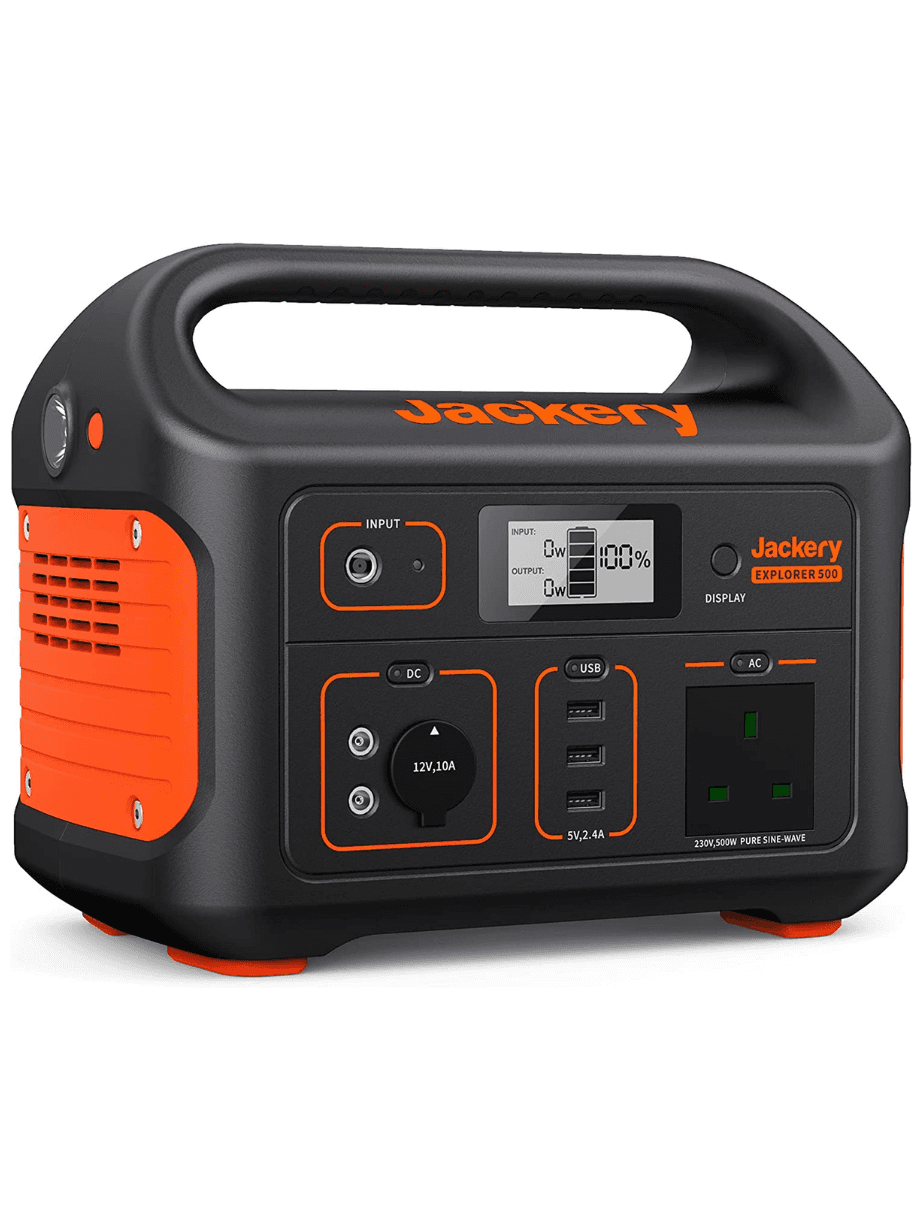
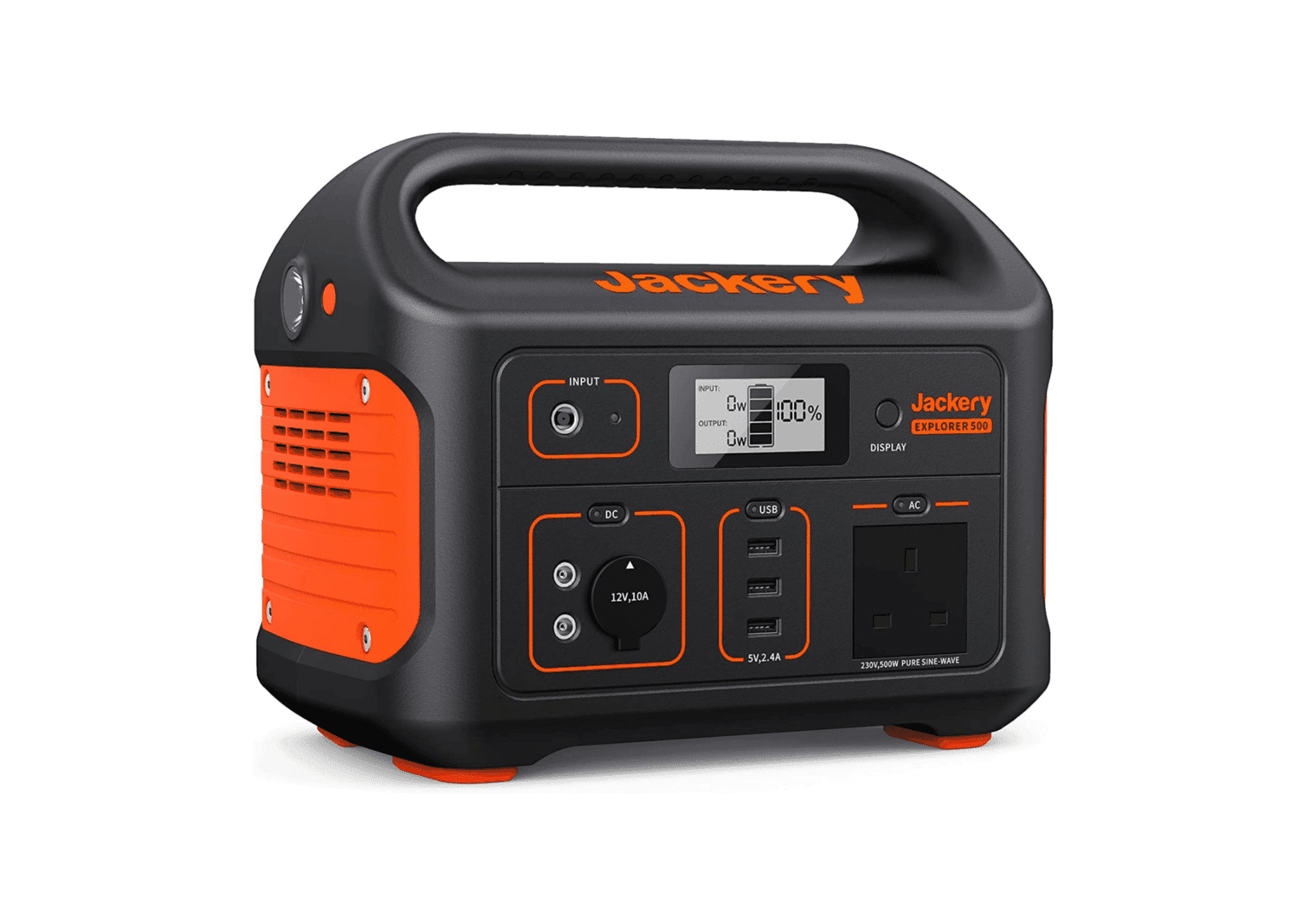

I've been testing the Jackery Explorer 500 for the past few weeks. It's a portable power station, a big rechargeable lithium battery with mains sockets, that you can charge from the mains, your car or a solar panel. Here's what it can power, who it suits, and whether it's worth the money.
Understanding the Jackery Explorer 500
It's compact for its capacity, with an AC socket, a car-style DC socket and USB ports, so it can run or charge most small devices away from mains power.
Key Features and Charging Options
Technical Specifications
- Battery Capacity: 518Wh (21.6V, 24Ah) using lithium-ion battery cells.
- Lifecycle: Over 500 cycles with 80%+ capacity retention.
- Recharge Options: AC wall outlet, 12V car outlet, and Jackery SolarSaga 100W solar panel.
Jackery Battery Info
- Capacity – 518Wh (21.6V, 24Ah)
- Cell – Li-ion NMC
- Lifecycle – 500 cycles to 80%+ capacity
Jackery Recharge Times
- AC Adapter – 7.5 hours
- 12V Car Adaptor – 8 hours
- SolarSaga 100W Solar Panel – 9.5 hours
Jackery Ports
- AC Output – 230V, 500W (1000W Surge)
- USB-A Output – 5V, 2.4A
- Car Output – 12V, 10A
- DC Output – 12V, 7A
- DC Input – 12V-30V (100W Max)

Charging the Explorer 500
Charging the Jackery 500 is straightforward, with three primary recharge backup choices:
- AC Adapter: Connect to a standard AC outlet for a full charge in approximately 7.5 hours.
- Car Port: Utilize the 12V car adaptor for charging during road trips, requiring around 8 hours.
- Jackery SolarSaga: For eco-friendly charging, the SolarSaga 100W panel (an optional accessory) offers easy green solar recharging, taking about 9.5 hours under full sun.
This solar solution not only emphasizes Jackery’s versatility but also its commitment to providing a sustainable power source via sun energy.

Jackery Explorer Output
The Jackery 500 is aimed very clearly at outdoor adventurers who are looking for a bit of power to get them through a long weekend of camping, without having to find campsites with electric hook-ups.
For the most part, that probably means that the Jackery 500 is going to be used for charging devices such as phones, cameras, laptops and maybe even drones. For the more serious campers, this usage could also include things like mini-coolers and TVs.
The Jackery website has some useful information on run times and recharges, but here are just a few of the stats that would be most relevant.
- Phone – 53 Charges
- Camera – 25 Charges
- Drone – 9 Charges
- Laptop – 4.5 Charges
- Mini Cooler – 9.5 Hours
- TV – 7.5 Hours
Power Output and Device Compatibility
The Jackery 500 is equipped with multiple output options, including an AC output port, USB-A, and direct current ports, catering to a variety of electrical devices and small appliances. Whether it’s charging phones, powering a compact design box fan, or keeping a CPAP machine running overnight, the Jackery 500’s pure sine wave inverter ensures safe and efficient operation.
Who Benefits Most from the Jackery Explorer 500?
It suits camper vans, car camping, festivals and family camping trips where you want to charge phones, run lights or a small fridge. It's light enough to carry by the handle, but it's not something you'd take backpacking.
Value For Money
At £529.99 for the unit alone, or £749.99 with the SolarSaga solar panel, it's a big investment. If you camp a lot off-grid, or want a backup for power cuts, it can be worth it. The built-in MPPT controller makes the most of solar charging.
Final Thoughts
The Jackery Explorer 500 is a reliable, easy-to-use power source for camping and van trips, and it doubles as backup power at home. Paired with the solar panel, it keeps you going off-grid for days. It's expensive, so it makes most sense if you'll use it regularly; for occasional weekends, a cheaper power bank and a campsite with hook-up will do.